Friday, September 29, 2006

Time Flies


"Another day in paradise" is a popular expression for the consistency of island life. In tropic and subtropical environments, time progresses but seasonal transitions aren't always so obvious. Sure, at some point it is cold here in SW Florida, the days get shorter and the rains taper off, but those crisp chilly mornings that remind so many folks of the waning of summer are not a part of our transition. Here on Sanibel, we are reminded of the passage of time by the composition of our birds. Wading birds aggregate in shallows, and small confusing warblers flock to our mangrove trees. In the photo above, an endangered Wood Stork arrives to the flats of Ding Darling National Wildlife Refuge as Double-Crested Cormorants take a break on an exposed bar. Not a bad deal, marking the passage of seasons by the 'bird calendar'; of course if you're not watching birds, watching the Gators on Saturday afternoons might just remind you that somewhere the mornings are crisp and the leaves are turning colors.

Monday, September 25, 2006


Where the forest meets the sea.

Habitats that lie within the intertidal zone are tough places to make a living. They are constantly changing. An environment that embodies that adage that nothing is consisten, but change. In the intertidal, water levels change, the salinity of the water changes, the presence of high energy waves, variable temperatures and with it, changing amounts of oxygen. All of these variables present special challenges to living things. In the face of such adversity, a group of woody plants has evolutionary risen to these challenges and marked sandy tropical and subtropical intertidal zones as their home turf. We call these spectacular woody trees and shrubs occupying the zone ever shifting between land and sea, mangroves. That habitat they dominate, we call mangals. There are approximately 54 species of mangrove trees throughout the world which belong to 16 different plant families. On Sanibel, there are technically four species of mangrove. We most commonly think of three species, the Red Mangrove, Black Mangrove and White Mangrove. And although not commonly thought of as such, the Buttonwood Tree is also classified as a mangrove.

This photograph is a red mangrove (Rhizophora mangal). This species is characterized by its highly developed system of aerial roots. These roots provide stability for the tree while allowing the roots to not penetrate deeply into the oxygen-depleted muds in which the tree grows. The labyrinth root system provides a structural platform for a myraid of sea life. Coon oysters (Isognomon alatus) commonly grow on aerial roots, and are thickly covering the roots in this picture. Lore has it that these little oysters are so named, because racoons can easily eat them at low tide. In addition to oysters, numerous other species of invertebrate live on and among the roots, including sponges, tunicates, and many crustaceans. Thanks to this structure and many invertebrates, small and/or juvenile fishes are also common in mangal communities... and where there are small fishes, big ones are surely close by, waiting to step up and do their part in the intricate food chain of the inetrtidal.

How lucky that woody trees have been able to slove the problems of living in tropical inertidal zones. They are the foundation of a series of food webs that create the magnificent ecosystems of near-shore marine environments. So, the next time you get a crunchy fried grouper sandwich take a moment to thank a mangrove.

Friday, June 23, 2006

Sea Hares


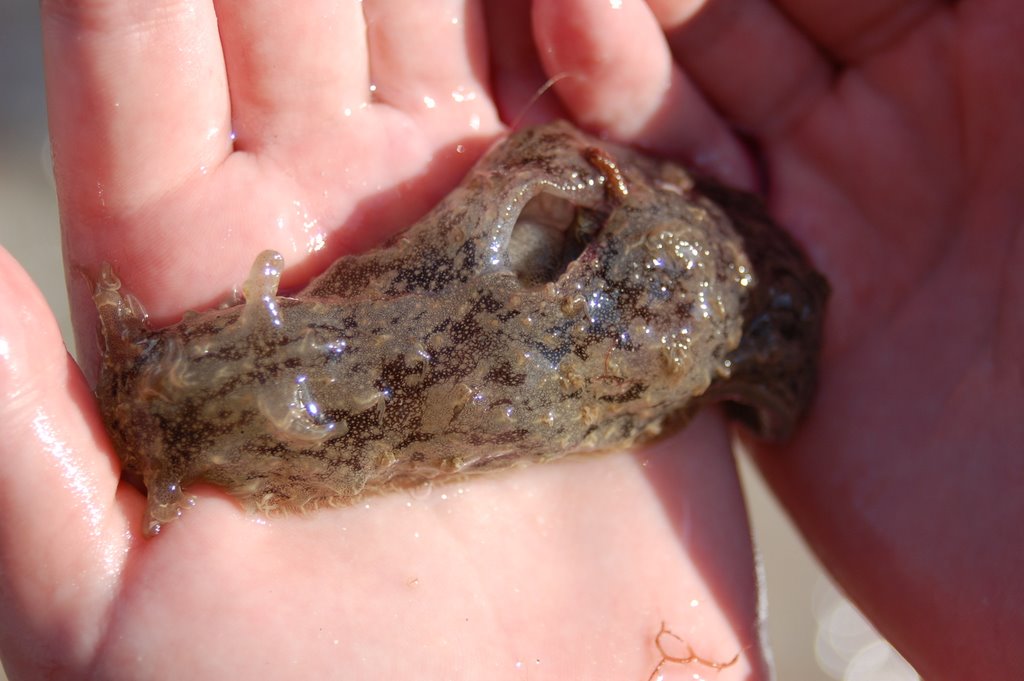
Amongst large rafts of red algae, we have recently found many sea hares washing up on Sanibel shores. The algae that has been washing up is considered by most to be an unpleasant addition to our shores, but it does make its own contributions. Among the algal mats tiny shrimp swim and crawl around, and there are a large number of sea slugs washed ashore that seem to be correlated to the presence of this algae. These interesting little gastropod molluscs are called Aplysia brasiliana, commonly known as sea hares. They are a type of sea slug that normally inhabits sea grass beds, are herbivores and graze on benthic algae. They have been extensively studied by neurophysiologists (scientists that study how nerve cells work) beacuse they have very large nerve cells (10-50 times larger than mammal nerve cells) that are orange in color. For more information about sea hares, visit http://www.seaslugforum.net/factsheet.cfm?base=aplybras. And the next time you see a green-brown blob on the beach, that exudes a purple ink when touched, check it out and introduce yourself to a sea hare. If you can return it to the water on an outgoing tide you might keep it from being stranded.

Thursday, June 22, 2006

The Last Moments of the Longest Day

On June 21, we noted the Summer Solstice. The Summer Solstice is one of the two days during the year when day and night are at their longest and shortest periods, depending upon where you are on Earth. Because of the tilt of the Earth on its axis, in the Northern Hemisphere the Summer Solstice is the longest day of the year, and in the Southern Hemishphere, the shortest. Because we are north of the equator on Sanibel (26.45271 N) we enjoy our longest day of the year, and this year we had about 13 hours and 48 minutes of daylight. Now the days get shorter and the nights longer until the Winter Solstice. For more information on the Solstice, see http://www.windows.ucar.edu/tour/link=/the_universe/uts/summer.html. Yesterday, we found numerous sea hares - a type of sea slug washed up on the beaches....today there were none. With each new tide, the sea brings us new surprises. More about sea hares tomorrow - the nights are short here this time of the year. Until then, enjoy the long days of summer. And use those daylight hours to sneak in some exploration the natural world that surrounds us.

Monday, June 12, 2006

The Sanibel Light - About the Only Thing that Happens on Sanibel After Dark

The Sanibel Lighthouse is an historic landmark located on the eastern edge of the island - for you gps buffs, that's 26.45271 x -82.0141. It was first illuminated in August of 1884 and was designed as a navigational aide to mark the mouth of San Carlos Bay. Its light is 98 feet above the ground and was created by a beautiful and very functionally complex, third order fresnel lens. Punta Rassa, on the mainland side of San Carlos Bay - across from Sanibel - near the current causeway is at the mouth of the Caloosahatchee River and was at the time, a thriving port that among other cargos loaded many cattle to be shipped to Havana. The lighthouse was one of two identical lighhouses, the other was placed at Cape San Blas, on the Florida Panhandle. While en-route to Sanibel, the ship carrying pieces for both lighhouses sank, divers were dispatched and sucessfully recovered the lighhouses. The Sanibel lighthouse sits on the eastern edge of Sanibel, and although it is not open to public tours, visitors may walk around the base of it and enjoy the shelling on nearby beaches and views of North Fort Meyers and on clear days of Naples to the southwest. Also check out the Sanibel fishing pier just west of the lighthouse - 'cause you never know, it might just be your lucky day. For a detailed discussion of fresnel lenses, visit http://www.michiganlights.com/fresnel.htm.

Tuesday, June 06, 2006

Snowy Plover Chicks


This is a Snowy Plover chick that hatched on the east end of Sanibel in early May. Snowy Plovers regularly nest on Sanibel and their chicks run about mostly unnoticed by the humans that pass within five feet of them

From NY to Sanibel


Today we are still in New York saying goodbye to all our good friends at Fieldston and Pennington and Chapel School and Sarah Lawrence Early Childhood Center and the American Museum of Natural History. We're saying to everyone, "come on down and visit us! Come to Sanibel Sea School! Come to our home! You can rent a few bikes and explore our island with us.

The movers come next week to pack up all those shells and egg cases and sea urchin tests and fish bones and turtle bones to move them back to the ocean!! What would an anthropologist make of Dr. Bruce Neill - carting bags of detritis home on a plane for years and years and then paying a moving company good hard-earned money to bring it all back, carefully wrapped in boxes (re-useable boxes)! We humans are splendid.

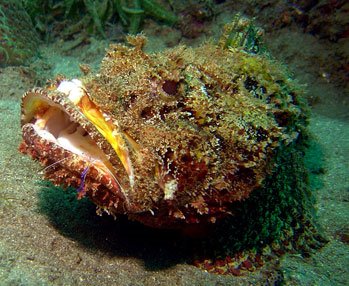
(Speaking of splendid, our friend Jamie, took this great photo of a scorpionfish. How do you like that camouflage. I bet his prey never know what hit them.)

I'll leave you all with something to ponder. All those handheld device chargers we leave plugged into outlets still use a little energy. In fact, chargers use about 5 watts an hour when nothing is plugged in to them!!! So, when you plug your device into to you, unplug your charger from the wall. Over and out, EV

Our New Blog Site

Welcome to Sanibel Sea School. We are develpoing a blog site to better share information about the natural world around southwest Florida. If you want more infromation about Sanibel Sea School, please visit us at sanibelseaschool.org, or just click on the link to your right.