Wednesday, June 13, 2007
Summer Starts With a Blast - Gopher Week
Friday, April 06, 2007
Can You Take Your Sea School Experience Home With You ?
Is That a Snake on the Beach???
Thursday, April 05, 2007
Who Says a Bus Ride Can't Be Fun
It is not Just the Sea
Monday, March 12, 2007
And Somtimes we have Some Fun !
And for fun, we watched several alligators enjoy the freshwater environments of Sanibel Island.
What happens when kids are hungry?
At Sanibel Sea School, we feed them a good, healthy lunch and magically they change back to the ever-so-wonderful kids that we knew from the morning.
Now, out to open some coconuts and then back to the field to study Lightning Whelks and their egg-cases.
Monday, March 05, 2007
Seeing Nature Eye to Eye
Followed by the freshest coconut in the world. Just the right combo to fuel young minds for an afternoon of exploration.
Tuesday, February 20, 2007
Doing the Quadrat Hula
Monday, February 19, 2007
Mud Forests
Friday, February 16, 2007
A Cold Day at the Ocean Always Beats a Day in School
Ms. O's fourth grade class from Canterbury School braved the winds and rain of winter weather of Florida to spend the day at Sanibel Sea School. Their efforts were rewarded with many great and exciting island adventures.
We tasted mangrove leaves, slipped in mud flats, found fiddler crabs, honed our skills of observation, added some new vocabulary words...was that ephemeral?
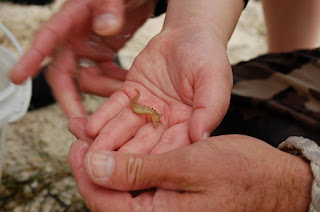
And in the seine, in the rain, we were lucky enough to catch several magnificent sea horses.
Mr. Murphy found a strange new creature never before seen to science and delighted us all with this important scientific discovery.
Sometimes it is easier to pay more attention on a field trip, in the field, in the cold, in the rain rather than sitting in a desk in a warm classroom on a wintery day. Go Figure.
At Sanibel Sea School, every day is a field trip.
Thursday, January 11, 2007
A Cold Blustery Day in Florida

Yes, even in SW Florida we have cold blustery days. But at Sanibel Sea School, our intrepid adevnturers go out to learn about and explore our natural bounty. Yesterday, the Robbins family of Carbondale, Illinois braved the elements to explore the mangrove communities on the north side of Sanibel. One of the things we learned is that mangrove forests, which grow in the intertidal zone are a great place at low tide to escape the howling winds and have some importnat, serious fun.
We also leaned that mangrove forets support a plethora of other organisms, ranging form worms to molluscs, crabs, fish, birds and even racoons.
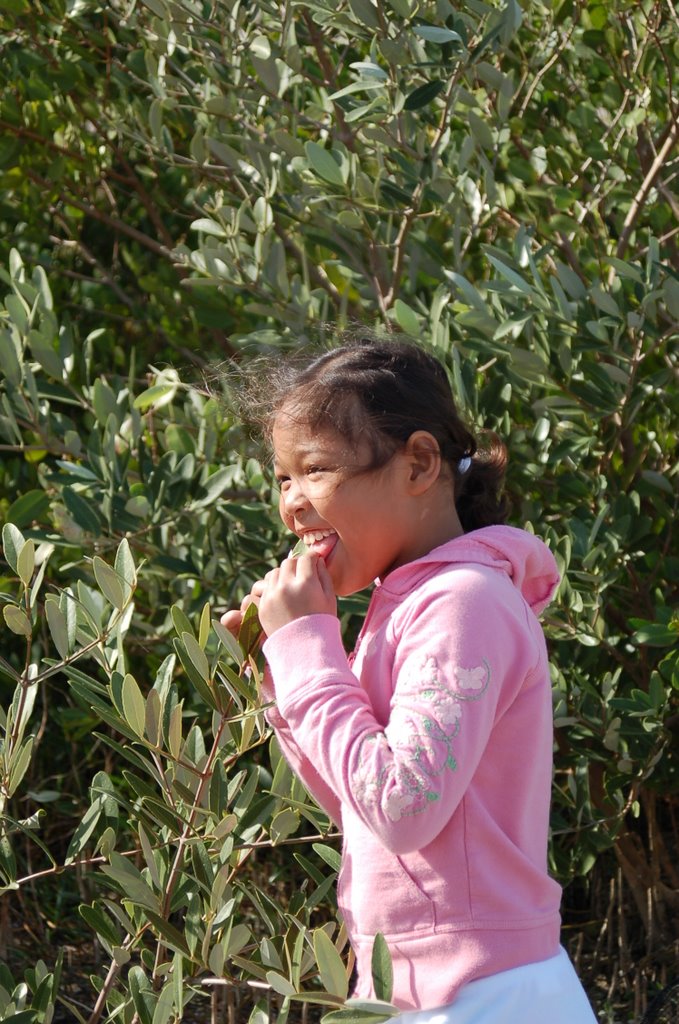
And sometimes different species of mangrove trees can be told from one-another based on the taste of their leaves! Black mangroves secrete salt from their leaves, while red mangrove's leaves are not as salty.
Jany Robbins demonstrates the leaf tasting procedures.

Wednesday, December 13, 2006
The Wonders of a Seahorse

Early Thanksgiving morning, a group of intrepid adventurers set out on the East End for a Sanibel Sea School early morning beach walk. One of the great things about a beach walk is that the rewards are directly related to the effort – the more you look, the more you find. And let’s face it, these days, few things in life are so simple and so direct.
And so we set forth, sleepy and cold to discover what the sea held for us. It was an unusually low tide and many sand dollars were evident just beneath the sand on the outer bar and there were other fascinating things, but mostly everyday stuff. When all of sudden, the kids let forth shrill, brilliant screams of delight. There amongst the red algae, in the moat between sandbars, they found a seahorse. A spectacular specimen – beautiful brown with long stripes – appropriately enough, a Lined Seahorse; this one was nearly five inches long.
Seahorses are fabulous animals. They, of course, are fish and while mostly overlooked, they are not really all that uncommon on Sanibel. They prefer seagrass meadows and mangrove habitats. There are about 50 species worldwide; we have two. And as a whole, they are not well known to science, but what we do know is that they are pretty amazing.
Most fish are broadcast spawners. They release eggs and sperm into the water to be fertilized, and the fry to fend for themselves, from the moment of conception, with no parental care. Some fish make nests and tend their eggs, and others actually carry developing eggs in their mouths. But in seahorses, the male literally becomes pregnant - a female deposits her eggs in a special pouch on the abdomen of the male. He fertilizes the eggs and seals the pouch until the eggs hatch and the young swim away. As they develop, the male provides nutrition and oxygen to the embryos, and he regulates the salinity of the pouch. The eggs mature in two to four weeks, and then the father goes into labor and squeezes out the 100 or so young. At that point, they are on their own.
And, most seahorses appear to be monogamous; they become pair-bonded and repeatedly mate with the same mate; some for a season, and some perhaps for life. The female comes around once or so a day and checks in with her mate. They dance for a few minutes and then go their separate ways until the next day. And usually within hours of the male releasing his brood, they undergo ritualistic mating dances lasting up to eight or nine hours. Their gyrating dances culminate with the female depositing more eggs to start the cycle again.
Fascinating stuff, but, early that blustery November morning, all these facts are lost; as well they should be, to the sheer joy of discovery of a great big old seahorse alive and well, in the moat between the sandbars, in the shadow of the Sanibel Lighthouse. One of the many things to be thankful for on our Sanctuary Island.
Thursday, November 02, 2006
A Great Day for Learning, Fish and Fun

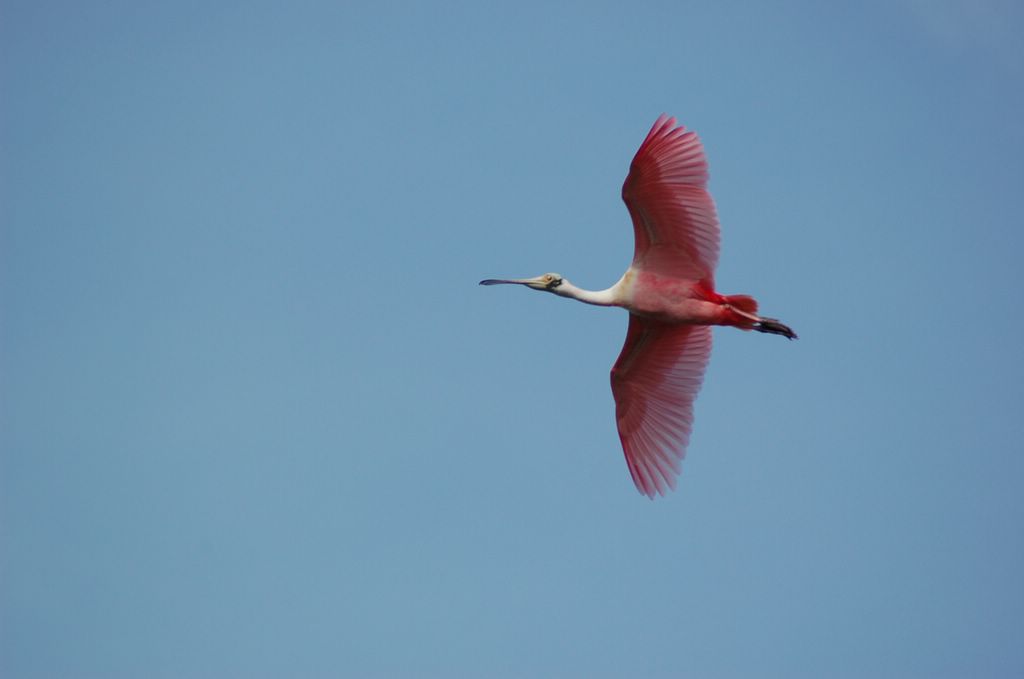
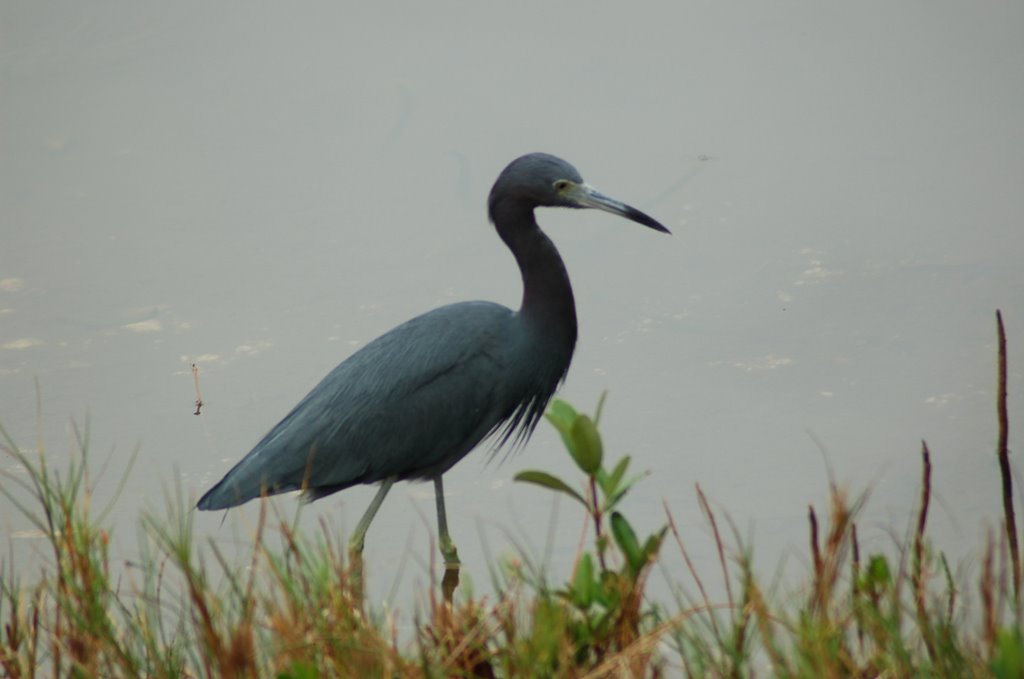
Today was one of those perfect days to be in the field in SW Florida. This Little Blue Heron posed for us on Wildlife Drive in Ding Darling National Wildlife Refuge. Then we saw a large group of White Pelicans. White Pelicans winter here and spend their summers in the Rocky Mountains. It is great to see old friends return to the Refuge. White Pelicans are much different than our beloved residents, the Brown Pelican. It is nice to see them side-by-side. We also got a peak of a nice little American Alligator.
Then we were off to the beach for some beach ecology lessons. We were had a nice d
ay of seining at the beach. Katie Schroll, of Medina, OH is shown here showing off some of the many fish we were able to seine off the beach. The weather here was a little warmer than back in Ohio.
Our Gulf waters are alive with baitfish this time of year and it is great to see these little creatures first-hand. We were also able to catch a large number of sand fleas in our seines.
And, of course, what would a field trip be without a little plain old fun?
Wednesday, November 01, 2006
Living on an Island in an Estuary

Most of us love living on an island, but let’s not kid ourselves, we really live in an estuary. Yes, on an island, but an island in an estuary. We are not a sentinel island standing alone in the sea. We are part of a magical place where continents, and the fresh water draining them meet the ocean. Estuaries are places of transition from one world to another, a cauldron of admixture, and in many ways a place of birth, reunion and rejuvenation. The most powerful forces on Earth, colliding.
If you’re like me, you feel a release, the moment you hit that bridge – west bound and home – to our little island. I’ve noticed the release comes when I first hit the bridge (the estuary), not always crossing to the island.
Estuaries are among the richest environments on Earth and oddly this richness blooms amidst eternal change. The fresh water brings with it a rich mixture of nutrients and materials from the continents – nutrients for marine plants to grow and flourish, which in turn provide the energy for vast and far-reaching ocean food webs.
Estuaries change – they vary in temperature, salinity, depth, nutrient levels, and the amount of sediment in the water. And, the pace of their change is rapid. They change with the tide, they change with the seasons, they change with the weather, and even the arc of the sun. To record environmental conditions of estuaries, scientists take measurements on a scale of minutes. Longer intervals allow changing conditions to go unnoticed. Electronic instruments that record various environmental parameters every several minutes are allowing us to better understand estuaries.
We are facing tough environmental challenges on our island. And rightly, many of us are at best, bewildered about our future. How we can help and what we can do to make things better – these issues perplex us. Often we are inundated by the onslaught of problems we face – what can we do? A first step is to recognize that our Sanctuary Island is not just an island, but part of an extensive estuary system. A system reaching from Gasparilla Island to our home here on Sanibel, and eastward into the middle regions of Florida. Estuaries are where rivers meet the ocean. The entire land region drained by a river is known as its watershed. So, really we are a part of the watersheds that are drained by the rivers that feed our estuary. Watershed management influences our environmental harmony.
A sanctuary island in an estuary that drains a watershed. Great, so how does this help us face our problems? We need to remember that we are not alone; we are a part of a system with shared problems and we will find shared solutions. It also helps me to realize our environmental problems are not acute, but chronic ones – we’re not running a short dash, but a marathon. We need to pace ourselves and make the appropriate choices to help conserve our island sanctuary in an estuary.
Most importantly, remember that we can solve our problems. If in doubt, just go to the beach and count the number of Brown Pelicans and compare that to what we saw thirty years ago. Once we recognize a problem and become dedicated to solving it, we can.
Over the coming weeks, I’ll be discussing our estuaries and small things you can do that make a cumulative difference. Until then, start to look at the big picture of estuaries. Find leaders who share your concerns and support them. Let’s walk through our environmental challenges with a clear eye and the faith that a positive outcome is possible.
Wednesday, October 18, 2006
It's Not Always a Photo Op Day
Monday, October 16, 2006
A Crocky Day in Paradise


Team crocodile endured a long, hot 3-mile hike today on the Indigo Trail of Ding Darling National Wildlife Refuge. We were rewarded by a close up look at a 12-foot American Crocodile. The photo above is not her, but an alligator we saw on our way to see her. Read more about it below. Wow, what a great way to start off the week!
We also saw Anhingas, a Bald Eagle, a 5-foot yellow rat snake, and a close-up look at a 9-foot Alligator. The alligator was missing it's right front forelimb. Check out the photo we got of it. In this photo you can see that none of its bottom teeth protrude above the upper teeth - one of the ways to tell crocs from alligators.
It was a giant relief to wade into the estuary, cool off and find oysters, horshoe crabs, and a young starfish after that long hike. Wading, and the "ice in the back of the shirt trick" was the perfect end to a long, hot, animal-packed hike.
Here's to you Stevie, and the crocs we all love. Another Day in Paradise.
Friday, September 29, 2006
Time Flies

"Another day in paradise" is a popular expression for the consistency of island life. In tropic and subtropical environments, time progresses but seasonal transitions aren't always so obvious. Sure, at some point it is cold here in SW Florida, the days get shorter and the rains taper off, but those crisp chilly mornings that remind so many folks of the waning of summer are not a part of our transition. Here on Sanibel, we are reminded of the passage of time by the composition of our birds. Wading birds aggregate in shallows, and small confusing warblers flock to our mangrove trees. In the photo above, an endangered Wood Stork arrives to the flats of Ding Darling National Wildlife Refuge as Double-Crested Cormorants take a break on an exposed bar. Not a bad deal, marking the passage of seasons by the 'bird calendar'; of course if you're not watching birds, watching the Gators on Saturday afternoons might just remind you that somewhere the mornings are crisp and the leaves are turning colors.
Monday, September 25, 2006

Where the forest meets the sea.
Habitats that lie within the intertidal zone are tough places to make a living. They are constantly changing. An environment that embodies that adage that nothing is consisten, but change. In the intertidal, water levels change, the salinity of the water changes, the presence of high energy waves, variable temperatures and with it, changing amounts of oxygen. All of these variables present special challenges to living things. In the face of such adversity, a group of woody plants has evolutionary risen to these challenges and marked sandy tropical and subtropical intertidal zones as their home turf. We call these spectacular woody trees and shrubs occupying the zone ever shifting between land and sea, mangroves. That habitat they dominate, we call mangals. There are approximately 54 species of mangrove trees throughout the world which belong to 16 different plant families. On Sanibel, there are technically four species of mangrove. We most commonly think of three species, the Red Mangrove, Black Mangrove and White Mangrove. And although not commonly thought of as such, the Buttonwood Tree is also classified as a mangrove.
This photograph is a red mangrove (Rhizophora mangal). This species is characterized by its highly developed system of aerial roots. These roots provide stability for the tree while allowing the roots to not penetrate deeply into the oxygen-depleted muds in which the tree grows. The labyrinth root system provides a structural platform for a myraid of sea life. Coon oysters (Isognomon alatus) commonly grow on aerial roots, and are thickly covering the roots in this picture. Lore has it that these little oysters are so named, because racoons can easily eat them at low tide. In addition to oysters, numerous other species of invertebrate live on and among the roots, including sponges, tunicates, and many crustaceans. Thanks to this structure and many invertebrates, small and/or juvenile fishes are also common in mangal communities... and where there are small fishes, big ones are surely close by, waiting to step up and do their part in the intricate food chain of the inetrtidal.
How lucky that woody trees have been able to slove the problems of living in tropical inertidal zones. They are the foundation of a series of food webs that create the magnificent ecosystems of near-shore marine environments. So, the next time you get a crunchy fried grouper sandwich take a moment to thank a mangrove.